
Sermon from Sunday 10 May
Church Now, Church Then?
Reading(s): Revelation 21:22 - 22:5 and Isaiah 43:19 - 21. This sermon was given by Ann Devereux at St Denys.
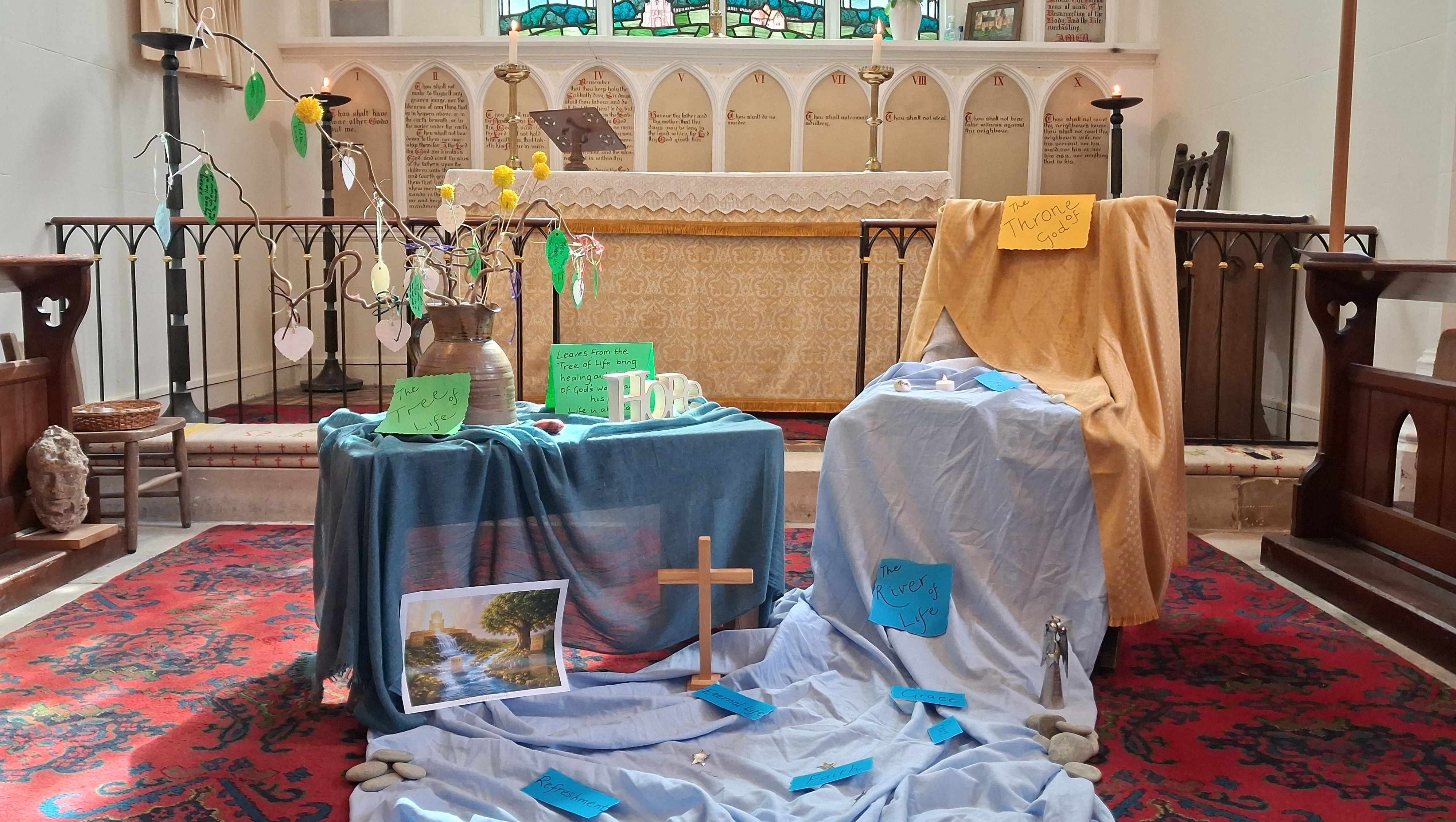
This photo is from the Sunday morning when this sermon was given and we had time to add prayers to leaves and put them on the tree of life.
Church buildings are used for a variety of events.
Like some of you here today I walked to the polling station on Thursday to vote in the local elections. The polling station was in a church hall next to the local church. Also, All Saints in North Baddesley will be without a church building in July when the roof is repaired. No church building. Does this mean we will be church-less?
It’s interesting to track where the church over the centuries has met.
In the book of Acts we see that Christians gathered in a variety of places and spaces, and as the gathered people of God, they were the Church. Over the years the word church has moved away from meaning, ‘the people who gather’, to, ‘the place where people gather’ in church halls and buildings.
One of the challenges that any church building faces when it comes to including all people are things like accessibility - such as ramps and hand rails; lighting and sound, such as loop systems; as well as peoples' anxiety regarding coming into a new and unfamiliar place; the possibility of rejection through not feeling like you belong, and not being known in the church by anyone. This is not likely to be an issue for many of you here today, but imagine if this was the first time that you had stepped into this church.
The passage from Revelation begins by explaining that in the ‘new’ city there is no temple and no building. This may strike us as unusual, as, throughout the Bible, the Temple has been a symbol of God’s dwelling place among his people, especially in Exodus, where the physical tabernacle moved with the people and was set up in the middle of the encampment each time they stopped. The tabernacle, the Temple, was where heaven touched earth, where sacrifices were made, and where God's glory resided.
Yet in the vision of the future, we learn that the very presence of God is the temple, and not a physical building. We will not need a physical structure to build a relationship with God, as He will be fully present, and we will experience unbroken communion with Him.
Verse 23 says that the city will not need the sun or the moon because the glory of God will give it light - a powerful reminder that God’s presence is the ultimate source of light and truth.
In a world often shrouded in darkness, and where uncertainty and fear can overwhelm us, we can find comfort in knowing that God’s glory can shine, even in the darkest times. The Church is called to reflect this light…
Jesus said, in Matthew 5, ‘You are the light of the world’. Therefore in our interactions and love for one another, we are called to mirror this light, drawing others into the hope and joy we have found in Jesus.
Verse 26 announces that all nations shall come to this city, bringing their individuality and diversity. What a wonderful picture of inclusivity in God’s kingdom!... The doors of the new city are open wide, inviting people from all nations and backgrounds. It’s a space for reconciliation, for breaking down barriers, and an invitation for everyone to experience the transformative love of Christ. In a world marked by division, this is a beautiful vision of grace and peace that seems impossible to imagine in today's world.
Through the centre of the city, is the river of the water of life, flowing from the throne of God (Chapter 22). This imagery symbolises nourishment, refreshment, and the eternal life and happiness we find in Christ.
Alongside the river is the tree of life, with 12 crops of fruit, a reminder of God’s abundant provision. Just as the tree was present at the beginning in the Garden of Eden, so too it will flourish at the end in the new city, signifying restoration and the fulfilment of God’s original plan for humanity… its leaves bring healing and wholeness - no curses, no shame, no destruction, but rather, life in abundance.
What a promise! No longer will we understand God in part, or through a confused haze… Reassuringly, God will be fully present as we are fully present.
So what does this mean for us here and now?
Some of us may feel distant from God, struggling with the weight of our circumstances. Yet, this promise assures us that a day is coming when we will dwell in God’s presence, fully known and fully loved.
The new city portrayed in this passage is not just a distant dream, or pie in the sky; it is a promise that can shape how we live and worship today.
Here are some questions and thoughts to ponder:
-
As the gathered church here in Chilworth, are we beacons of light offering hope and truth?
-
As you are aware we are part of the Inclusive Church Network. Does our welcome go beyond words, and genuinely draw people into this community that celebrates diversity and grace?
-
And finally, is this church a place where people can truly meet God?